

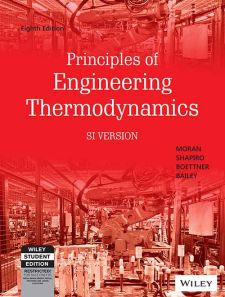
Principles of Engineering Thermodynamics, SI Version, 8ed
ISBN: 9788126556724
888 pages
For more information write to us at: acadmktg@wiley.com
Description
This new edition provides a student-friendly approach that emphasizes the relevance of thermodynamics principles to some of the most critical issues of today and coming decades, including a wealth of integrated coverage of energy and the environment, biomedical / bioengineering, as well as emerging technologies. Visualization skills are developed and basic principles demonstrated through a complete set of animations that have been interwoven throughout. It also introduces co-authors Daisie Boettner and Margaret Bailey, who bring their rich backgrounds of success in teaching and research in thermodynamics to the text.
1 Getting Started: Introductory Concepts and Definitions
1.1 Using Thermodynamics
1.2 Defining Systems
1.3 Describing Systems and Their Behavior
1.4 Measuring Mass, Length, Time and Force
1.5 Specific Volume
1.6 Pressure
1.7 Temperature
1.8 Engineering Design and Analysis
1.9 Methodology for Solving Thermodynamics Problems
2 Energy and the First Law of Thermodynamics
2.1 Reviewing Mechanical Concepts of Energy
2.2 Broadening our Understanding of Work
2.3 Broadening our Understanding of Energy
2.4 Energy Transfer by Heat
2.5 Energy Accounting: Energy Balance for Closed Systems
2.6 Energy Analysis of Cycles
2.7 Energy Storage
3 Evaluating Properties
3.1 Getting Started
3.2 p--ðœ--T Relation
3.3 Studying Phase Change
3.4 Retrieving Thermodynamic Properties
3.5 Evaluating Pressure, Specific Volume and Temperature
3.6 Evaluating Specific Internal Energy and Enthalpy
3.7 Evaluating Properties using Computer Software
3.8 Applying the Energy Balance Using Property Tables and Software
3.9 Introducing Specifi c Heats cðœand cp
3.10 Evaluating Properties of Liquids and Solids
3.11 Generalized Compressibility Chart
3.12 Introducing the Ideal Gas Model
3.13 Internal Energy, Enthalpy and Specific Heats of Ideal Gases
3.14 Applying the Energy Balance Using Ideal Gas Tables, Constant Specific Heats and Software
3.15 Polytropic Process Relations
4 Control Volume Analysis Using Energy
4.1 Conservation of Mass for a Control Volume
4.2 Forms of the Mass Rate Balance
4.3 Applications of the Mass Rate Balance
4.4 Conservation of Energy for a Control Volume
4.5 Analyzing Control Volumes at Steady State
4.6 Nozzles and Diffusers
4.7 Turbines
4.8 Compressors and Pumps
4.9 Heat Exchangers
4.10 Throttling Devices
4.11 System Integration
4.12 Transient Analysis
5 The Second Law of Thermodynamics
5.1 Introducing the Second Law
5.2 Statements of the Second Law
5.3 Irreversible and Reversible Processes
5.4 Interpreting the Kelvin--Planck Statement
5.5 Applying the Second Law to Thermodynamic Cycles
5.6 Second Law Aspects of Power Cycles Interacting with Two Reservoirs
5.7 Second Law Aspects of Refrigeration and Heat Pump Cycles Interacting with Two Reservoirs
5.8 The Kelvin and International Temperature Scales
5.9 Maximum Performance Measures for Cycles Operating between Two Reservoirs
5.10 Carnot Cycle
5.11 Clausius Inequality
6 Using Entropy
6.1 Entropy--A System Property
6.2 Retrieving Entropy Data
6.3 Introducing the T dS Equations
6.4 Entropy Change of an Incompressible Substance
6.5 Entropy Change of an Ideal Gas
6.6 Entropy Change in Internally Reversible Processes of Closed Systems
6.7 Entropy Balance for Closed Systems
6.8 Directionality of Processes
6.9 Entropy Rate Balance for Control Volumes
6.10 Rate Balances for Control Volumes at Steady State
6.11 Isentropic Processes
6.12 Isentropic Efficiencies of Turbines, Nozzles, Compressors and Pumps
6.13 Heat Transfer and Work in Internally Reversible, Steady-State Flow Processes
7 Exergy Analysis
7.2 Conceptualizing Exergy
7.3 Exergy of a System
7.4 Closed System Exergy Balance
7.5 Exergy Rate Balance for Control Volumes at Steady State
7.6 Exergetic (Second Law) Efficiency
7.7 Thermoeconomics
8 Vapor Power Systems
8.1 Introducing Vapor Power Plants
8.2 The Rankine Cycle
8.3 Improving Performance--Superheat, Reheat and Supercritical
8.4 Improving Performance-- Regenerative Vapor Power Cycle
8.5 Other Vapor Power Cycle Aspects
8.6 Case Study: Exergy Accounting of a Vapor Power Plant
9 Gas Power Systems
9.1 Introducing Engine Terminology
9.2 Air-Standard Otto Cycle
9.3 Air-Standard Diesel Cycle
9.4 Air-Standard Dual Cycle
9.5 Modeling Gas Turbine Power Plants
9.6 Air-Standard Brayton Cycle
9.7 Regenerative Gas Turbines
9.8 Regenerative Gas Turbines with Reheat and Intercooling
9.9 Gas Turbine--Based Combined Cycles
9.10 Integrated Gasification Combined-Cycle Power Plants
9.11 Gas Turbines for Aircraft Propulsion
9.12 Compressible Flow Preliminaries
9.13 Analyzing One-Dimensional Steady Flow in Nozzles and Diffusers
9.14 Flow in Nozzles and Diffusers of Ideal Gases with Constant Specific Heats
10 Refrigeration and Heat Pump Systems
10.1 Vapor Refrigeration Systems
10.2 Analyzing Vapor-Compression Refrigeration Systems
10.3 Selecting Refrigerants
10.4 Other Vapor-Compression Applications
10.5 Absorption Refrigeration
10.6 Heat Pump Systems
10.7 Gas Refrigeration Systems
11 Thermodynamic Relations
11.1 Using Equations of State
11.2 Important Mathematical Relations
11.3 Developing Property Relations
11.4 Evaluating Changes in Entropy, Internal Energy and Enthalpy
11.5 Other Thermodynamic Relations
11.6 Constructing Tables of Thermodynamic Properties
11.7 Generalized Charts for Enthalpy and Entropy
11.8 p--ðŠ--T Relations for Gas Mixtures
11.9 Analyzing Multicomponent Systems
12 Ideal Gas Mixture and Psychrometric Applications
12.1 Describing Mixture Composition
12.2 Relating p, V and T for Ideal Gas Mixtures
12.3 Evaluating U, H, S and Specific Heats
12.4 Analyzing Systems Involving Mixtures
12.5 Introducing Psychrometric Principles
12.6 Psychrometers: Measuring the Wet-Bulb and Dry-Bulb Temperatures
12.7 Psychrometric Charts
12.8 Analyzing Air-Conditioning Processes
12.9 Cooling Towers
13 Reacting Mixtures and Combustion
13.1 Introducing Combustion
13.2 Conservation of Energy-- Reacting Systems
13.3 Determining the Adiabatic Flame Temperature
13.4 Fuel Cells
13.5 Absolute Entropy and the Third Law of Thermodynamics
13.6 Conceptualizing Chemical Exergy
13.7 Standard Chemical Exergy
13.8 Applying Total Exergy
14 Chemical and Phase Equilibrium
14.1 Introducing Equilibrium Criteria
14.2 Equation of Reaction Equilibrium
14.3 Calculating Equilibrium Compositions
14.4 Further Examples of the Use of the Equilibrium Constant
14.5 Equilibrium between Two Phases of a Pure Substance
14.6 Equilibrium of Multicomponent, Multiphase Systems
Chapter Summary and Study Guide
Appendix Tables, Figures and Charts
Index to Tables in SI Units
Index to Figures and Charts
Index