

Wiley's Halliday / Resnick / Walker Physics for JEE (Main & Advanced), Vol II, 4ed, 2026
ISBN: 9789363865150
996 pages
Publication Year: 2025
For more information write to us at: acadmktg@wiley.com
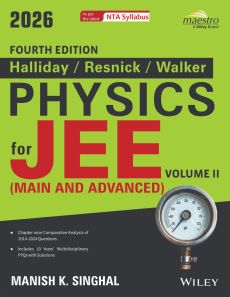
Description
This adapted version of one of the world’s most successful books on Physics combines Halliday, Resnick and Walker’s approach to Physics with JEE requirements. The book has been designed to help the students overcome the hurdles while preparing for JEE in terms of concepts and problem-solving.
Preface
Acknowledgments
Note to the Student
A Chapter wise Comparative Analysis of JEE Advanced
(2014–2024) Questions with Focus Topics
22 Electric Charges and Fields
22.1 What is Physics?
22.2 Electric Charge
22.3 Coulomb’s Law
22.4 Charge is Quantized
22.5 Charge is Conserved
22.6 The Electric Field
22.7 Electric Field Lines
22.8 The Electric Field Due to a Point Charge
22.9 The Electric Field Due to an Electric Dipole
22.10 The Electric Field Due to a Line of Charge
(Continuous Charge Distribution)
22.11 The Electric Field Due to a Charged Disk
22.12 Electric Field Inside a Conductor
22.13 A Point Charge in an Electric Field
22.14 A Dipole in an Electric Field
22.15 Electrostatic Shielding
Review and Summary
Problems
Practice Questions
Answer Key
23 Gauss’ Law
23.1 What is Physics?
23.2 Electric Flux
23.3 Gauss’ Law
23.4 A Charged Isolated Conductor
23.5 Applying Gauss’ Law: Spherical Symmetry
23.6 Applying Gauss’ Law: Cylindrical Symmetry
23.7 Applying Gauss’ Law: Planar Symmetry
Review and Summary
Problems
Practice Questions
Answer Key
24 Electric Potential
24.1 What is Physics?
24.2 Electric Potential and Electric
Potential Energy
24.3 Equipotential Surfaces
24.4 Calculating the Potential from the Field
24.5 Potential Due to a Point Charge
24.6 Potential Due to a Group of Point
Charges
24.7 Potential Due to a Continuous Charge
Distribution
24.8 Calculating the Field from the Potential
24.9 Potential Due to an Electric Dipole
24.10 Electric Potential Energy of a System of
Charged Particles
24.11 Potential of a Charged Isolated Conductor
24.12 Earthing
24.13 Electrostatic Self-Energy
Review and Summary
Problems
Practice Questions
Answer Key
25 Capacitance
25.1 What is Physics?
25.2 Capacitance
25.3 Calculating the Capacitance
25.4 Capacitors in Parallel and in Series
25.5 Energy Stored in an Electric Field
25.6 Capacitor with a Dielectric
25.7 Dielectrics: An Atomic View
25.8 Dielectrics and Gauss’ Law
Review and Summary
Problems
Practice Questions
Answer Key
26 Current and Resistance
26.1 What is Physics?
26.2 Electric Current
26.3 Current Density
26.4 Resistance and Resistivity
26.5 Ohm’s Law
26.6 A Microscopic View of Ohm’s Law
26.7 Power in Electric Circuits
26.8 Semiconductors
26.9 Superconductors (Optional)
Review and Summary
Problems
Practice Questions
Answer Key
27 Circuits
27.1 What is Physics?
27.2 Work, Energy, and EMF
27.3 Calculating the Current in a Single-Loop
Circuit
27.4 Potential Difference Between
Two Points
27.5 Multiloop Circuits
27.6 Electricity-Related Instruments
27.7 RC Circuits
Review and Summary
Problems
Practice Questions
Answer Key
28 Magnetic Force
28.1 What is Physics?
28.2 What Produces a Magnetic Field?
28.3 The Definition of B
28.4 A Circulating Charged Particle
28.5 Cyclotrons
28.6 Crossed Fields: Discovery of the Electron
28.7 The Hall Effect
28.8 Magnetic Force on a Current-Carrying Wire
28.9 Torque on a Current Loop
28.10 The Magnetic Dipole Moment
Review and Summary
Problems
Practice Questions
Answer Key
29 Magnetic Fields Due to Currents
29.1 What is Physics?
29.2 Calculating the Magnetic Field Due
to a Current
29.3 Magnetic Field of Moving Charged
Particles
29.4 Force Between Two Parallel Currents
29.5 Ampere’s Law
29.6 Solenoids and Toroids
29.7 Limitations of Ampere’s Law
29.8 A Note About the Frames of Reference
Review and Summary
Problems
Practice Questions
Answer Key 355
30 Maxwell’s Equations; Magnetism of Matter
30.1 What is Physics?
30.2 Gauss’ Law for Magnetic Fields
30.3 Induced Magnetic Fields
30.4 Displacement Current
30.5 Magnets
30.6 Magnetism and Electrons
30.7 Diamagnetism
30.8 Paramagnetism
30.9 Ferromagnetism
Review and Summary
Questions
Problems
Answer Key
31 Electromagnetic Induction
31.1 What is Physics?
31.2 Gauss’ Law of Magnetic Fields
31.3 Two Experiments
31.4 Faraday’s Law of Induction
31.5 Lenz’s Law
31.6 Motional EMF
31.7 Induction and Energy Transfers
31.8 Induced Electric Fields
31.9 Inductors and Inductance
31.10 Self-Induction
31.11 RL Circuits
31.12 Energy Stored in a Magnetic Field
31.13 Mutual Induction
Review and Summary
Problems
Practice Questions
Answer Key
32 Electromagnetic Oscillations
and Alternating Current
32.1 What is Physics?
32.2 LC Oscillations, Qualitatively
32.3 The Electrical–Mechanical Analogy
32.4 LC Oscillations, Quantitatively
32.5 Alternating Current
32.6 Three Simple Circuits
32.7 The Series RLC Circuit
32.8 Power in Alternating-Current Circuits
32.9 Transformers
Review and Summary
Problems
Practice Questions
Answer Key
33 Electromagnetic Waves
33.1 What is Physics?
33.2 Maxwell’s Rainbow
33.3 The Traveling Electromagnetic Wave,
Qualitatively
33.4 The Traveling Electromagnetic Wave,
Quantitatively ix
33.5 Energy Transport and the Poynting Vector
33.6 Radiation Pressure
33.7 Polarization
33.8 Reflection and Refraction
33.9 Polarization by Reflection
33.10 Polarization by Scattering
Review and Summary
Problems
Practice Questions
Answer Key
34 Geometrical Optics: Reflection
34.1 What is Physics?
34.2 Principle of Rectilinear Propagation of Light
34.3 Laws of Reflection
34.4 Formation of Image by a Mirror
34.5 Formation of Images by Spherical Mirrors
Review and Summary
Problems
Practice Questions
Answer Key
35 Geometrical Optics: Refraction
35.1 What is Physics?
35.2 Snell’s Laws of Refraction
35.3 Total Internal Reflection
35.4 Spherical Refracting Surfaces
35.5 Thin Spherical Lenses
35.6 Lens Mirror Combination
35.7 Prism
35.8 Chromatic Dispersion
35.9 Optical Instruments
Review and Summary
Problems
Practice Questions
Answer Key
36 Interference and Diffraction
36.1 What is Physics?
36.2 Light as a Wave
36.3 Diffraction
36.4 Young’s Interference Experiment
36.5 Coherence
36.6 Intensity in Double-Slit Interference
36.7 Modifications of Young’s Double-Slit Experiment
Experiment
36.8 Interference from Thin Films
36.9 Diffraction and the Wave Theory of Light
36.10 Diffraction by a Single Slit: Locating
the Minima
36.11 Intensity in Single-Slit Diffraction,
Quantitatively
36.12 Diffraction by a Circular Aperture
36.13 Diffraction by a Double Slit
Review and Summary
Problems
Practice Questions
Answer Key
37 Relativity (Optional)
37.1 What is Physics?
37.2 The Postulates
37.3 Measuring an Event
37.4 The Relativity of Simultaneity
37.5 The Relativity of Time
37.6 The Relativity of Length
37.7 The Lorentz Transformation
37.8 Electricity and Magnetism
37.9 The Relativity of Velocities
37.10 Doppler Effect for Light
37.11 A New Look at Momentum
37.12 A New Look at Energy
Review and Summary
Problems
Practice Questions
Answer Key
38 Photons and Matter Waves
38.1 What is Physics?
38.2 The Photon, the Quantum of Light
38.3 The Photoelectric Effect
38.4 Photons Have Momentum
38.5 Light as a Probability Wave
38.6 Electrons and Matter Waves
38.7 Schrödinger’s Equation (Optional)
38.8 Heisenberg’s Uncertainty Principle (Optional)
38.9 Reflection from a Potential Step (Optional)
38.10 Tunneling Through a Potential Barrier (Optional)
Review and Summary
Problems
Practice Questions
Answer Key
39 Hydrogen Atom
39.1 What is Physics?
39.2 String Waves and Matter Waves
39.3 Energies of a Trapped Electron
39.4 Wave Functions of a Trapped Electron
39.5 The Bohr Model of the Hydrogen Atom
39.6 Quantum Numbers for the
Hydrogen Atom
Review and Summary
Problems
Practice Questions
Answer Key
40 All About Atoms
40.1 What is Physics
40.2 Some Properties of Atoms (Optional)
40.3 Angular Momentum, Magnetic Dipole
Moments (Optional)
40.4 The Pauli Exclusion Principle (Optional)
40.5 Building the Periodic Table (Optional)
40.6 X Rays and the Ordering of the Elements
40.7 Lasers and Laser Light (Optional)
40.8 How Lasers Work (Optional)
Review and Summary
Problems
Practice Questions
Answer Key
41 The Nucleus
41.1 What is Physics?
41.2 Discovering the Nucleus
41.3 Some Nuclear Properties
41.4 Radioactive Decay
41.5 Alpha Decay
41.6 Beta Decay
41.7 Gamma Decay
41.8 Radioactive Dating
41.9 Nuclear Models (Optional)
41.10 Nuclear Fission: The Basic Process
41.11 Thermonuclear Fusion: The Basic Process
41.12 Thermonuclear Fusion in the
Sun and Other Stars
Review and Summary
Problems
Practice Questions
Answer Key
42 Conduction of Electricity in Solids
42.1 What is Physics?
42.2 The Electrical Properties of Metals
42.3 Semiconductors and Doping
42.4 The p-n Junction and the Transistor
42.5 Logic Gates
Review and Summary
Questions
Problems
Answer Key
Appendix A Some Fundamental Constants
of Physics
Appendix B Mathematical Formulas
Appendix C Properties of the Elements
Appendix D JEE Advanced / Multidisciplinary
PYQs with Answers and Solutions
Appendix E JEE Main 2025 Questions
with Solutions